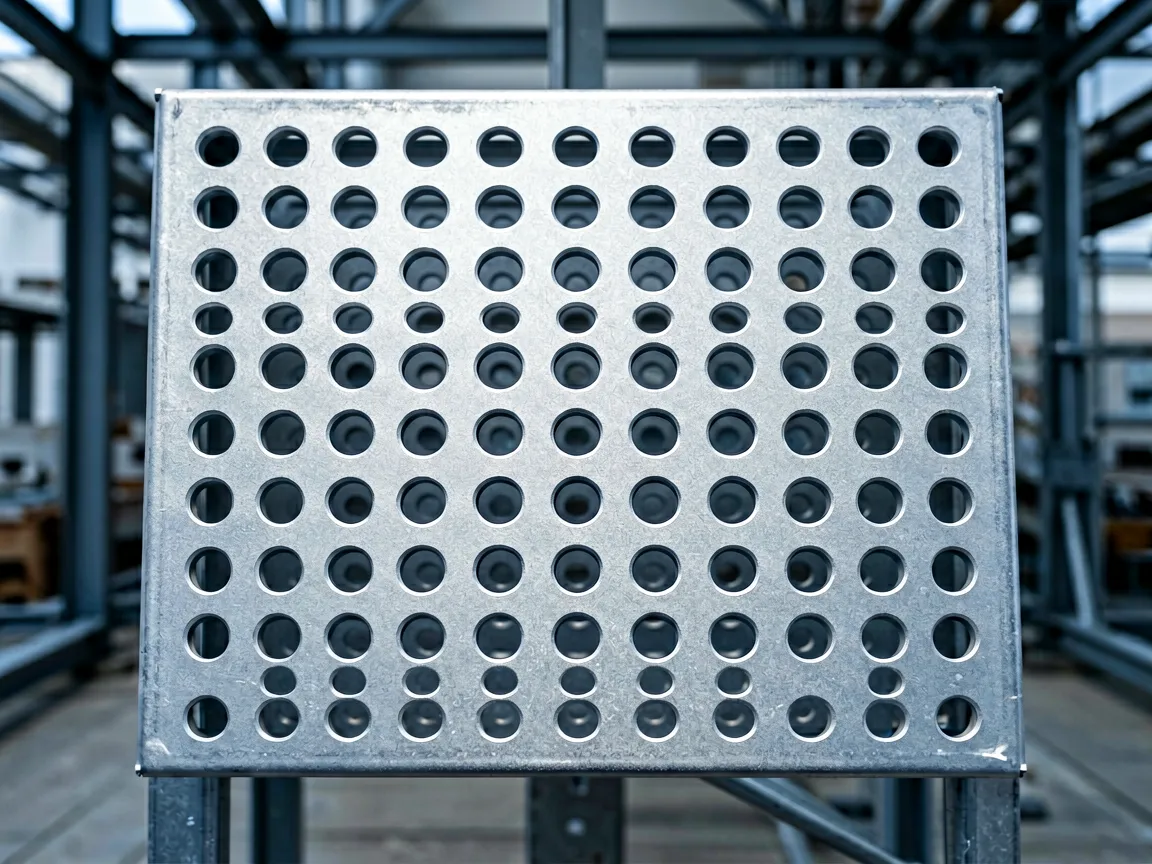
Why Perforated Ceilings Are Priced Per Square Meter, Not Per Ton
Unlike raw steel coils or plates, perforated metal ceilings are almost never sold by weight. The industry standard is per-square-meter (㎡) pricing, and for good reason. First, specification variation is enormous. Panel thickness typically ranges from 0.4mm to 1.5mm, meaning the same ton of material can yield anywhere from ~85 sqm (1.5mm steel) to ~740 sqm (0.5mm aluminum). Second, processing costs are substantial and not proportional to weight alone. CNC punching, tool wear, cutting, and surface treatments such as powder coating, PVDF painting, or anodizing add significant value. Third, the entire construction chain — architects, contractors, installers, and procurement teams — plans and budgets in square meters of coverage, making per-sqm pricing the only practical comparison metric.
Current Material-Only Price Ranges (Late 2026)
The following approximate per-square-meter prices cover the panel itself, excluding suspension systems, accessories, and installation labor. Typical add-ons range from $5–$15 per sqm.
Converting Per-Ton Cost to Per-Sqm: The Formula
If you need to estimate from raw material prices, use these steps:
**Step 1 — Calculate yield (sqm per ton):**
- Aluminum: Yield = 1,000,000 ÷ (thickness_mm × 2.7)
- Steel: Yield = 1,000,000 ÷ (thickness_mm × 7.85)
**Step 2 — Add processing layers:**
- Raw material: 60–80% of total cost
- Perforation + cutting: 10–20%
- Surface treatment: 10–25%
- Packaging + overhead: 5–10%
**Step 3 — Example calculation:**
A 1.0mm aluminum panel powder-coated with standard round holes:
- Aluminum ingot average: $2,775 / MT
- Yield at 1.0mm: ~370 sqm / ton
- Raw material per sqm: ~$7.50
- Processing + coating (+30%): ~$2.25
- Estimated total: ~$9.75 / sqm, which falls within the $8.5–$16.5 market range.
Key Price Factors That Drive Cost
1. **Material type** — Galvanized steel is the most economical; aluminum offers a balance of weight and corrosion resistance; 304 stainless is premium and hygienic; 316 stainless is reserved for coastal or highly corrosive settings.
2. **Panel thickness** — Thicker panels cost more per sqm because they contain more material, but they also deliver superior rigidity, longer span capability, better acoustics, and a more premium look. Common applications: standard office ceilings use 0.5–0.7mm; high-traffic commercial areas use 0.8–1.0mm; outdoor or heavy-duty installations require 1.0–1.5mm.
3. **Hole pattern and diameter** — Simple round holes in a standard pitch are the most cost-effective. Small diameters (<2mm), dense patterns, or decorative shapes increase scrap loss and often require custom tooling fees ($150–$800), though these are frequently waived for large orders.
4. **Surface treatment** — Powder coating is the baseline. Baked enamel adds 10–20%, PVDF fluorocarbon adds 40–80%, anodizing adds 30–60%, and wood-grain transfer can add 50–100%. For exterior or high-durability requirements, PVDF or anodized finishes are strongly recommended.
5. **Order volume** — Larger quantities reduce per-unit cost through lower tooling amortization, bulk material discounts, and more efficient production runs. Moving from a sample order to a full project order can cut per-sqm pricing by 15–30%.
Procurement Recommendations
**For engineering and project procurement:**
**For small or DIY projects:**
Quick Decision Guide
Need a custom quotation? Send your drawings along with material type, thickness, hole pattern, panel dimensions, quantity, surface finish specification, and project location, and we will provide a detailed per-square-meter quote within 24 hours.